
.png)
What’s Actually Happening to Your Body?
-
Eating the same as always, but carrying more around your middle?
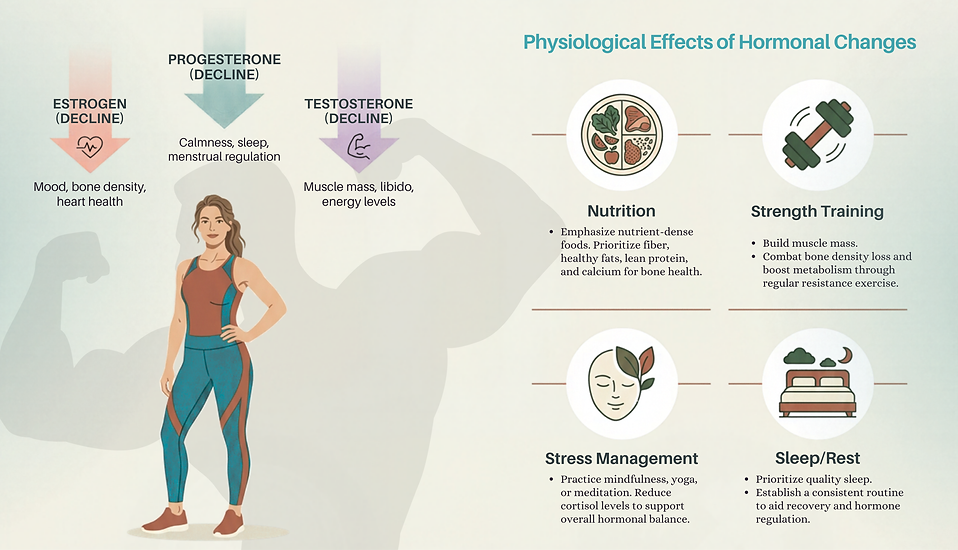
Falling hormones change how your cells handle carbohydrates, directing more energy into fat storage especially around the abdomen.
This means: it's not a willpower problem it's a strategy problem, and the strategy can change.
-
Strength feeling harder to hold onto?
Lower testosterone and estrogen make it harder for your body to build and maintain lean muscle, which lowers your baseline metabolic rate.
This means: the right training protects the muscle that protects your metabolism.
-
Wired at night, wiped out all day, and training isn't paying off?
Chronic stress and poor sleep keep cortisol elevated, which blunts recovery and makes it harder for your body to adapt to training.
This means: recovery is part of the plan, not something to push through.
.png)
The Clinical Assessment Difference: Nutrition + Strength
I don't hand you a generic PDF meal plan or tell you to "eat clean." As a Registered Clinical Nutritionist and Strength Coach, I combine internal lab interpretation with progressive physical programming.
-
Clinical Lab & Symptom Evaluation: I review your symptom timeline, blood markers, and health history rather than guessing.
-
Metabolic Strategy: Targeted macronutrient distribution that stabilizes blood sugar and restores daily cellular energy.
-
Wondering if training even works for your body anymore?
Prescriptive strength training protects bone density and stimulates muscle protein synthesis — the process your body needs to build and hold onto lean muscle.
This means: a training plan built to work with your changing physiology, not against it.
Common Symptoms I Address
-
Stubborn Abdominal Weight Resistance: Fat accumulation around the middle that resists standard dieting.
-
Unexplainable Fatigue & Brain Fog: Energy crashes and cognitive sluggishness tied to blood sugar and hormone shifts.
-
Sleep Disruption & Night Sweats: Fragmented sleep patterns that undermine daily recovery.
-
Losing strength you used to have, and taking longer to bounce back?
Declining hormones affect how your body maintains muscle and recovers from training in both men and women.
This means: strength and recovery you can rebuild, once I address what's actually changed.
-
Mood Swings & Anxiety Spikes: Unpredictable emotional shifts tied to systemic hormonal drops.
.png)
Frequently Asked Questions
Why does "eat less, move more" fail during perimenopause and menopause?
Answer: When your hormones change, cutting calories without enough protein and resistance training causes a greater share of the weight lost to come from muscle rather than fat. Without strength training to preserve lean tissue, severe calorie restriction lowers your metabolic rate and accelerates fatigue.
How does strength coaching help with hormonal changes?
Answer: Prescriptive strength training creates mechanical tension that signals your body to protect bone density, stimulate muscle protein synthesis, and maintain long-term metabolic health regardless of hormonal dips.